
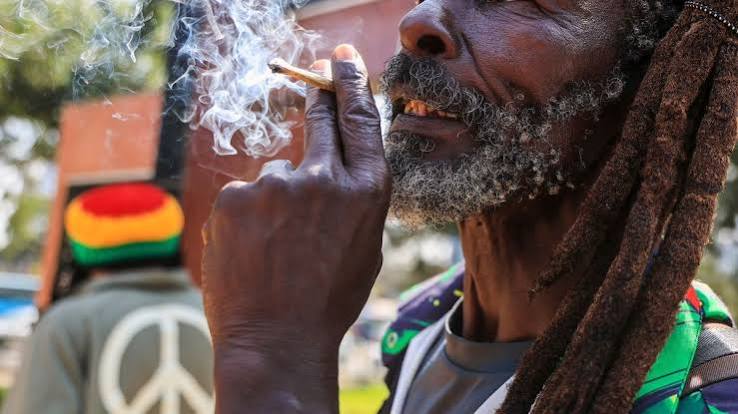
File #003: The Holy Herb
The High Court upheld Kenya’s bhang ban last week. Then the judge called the status quo untenable. Inside a judgment at war with itself.
The Story
Bhang can cost you ten years in prison. The judge who just confirmed that also asked, in the same ruling, whether arresting people for a spliff is a good use of Kenya’s police.
Hold both of those thoughts.
The answer was no. Total, on every ground.
But buried in the same judgment is the most surprising thing a Kenyan court has said about bhang in decades. And whether you pray with the herb, avoid it completely, or just know someone in a cell because of it, that part concerns you.
Start with a man carrying seeds through a metal detector.
Last Wednesday morning, Justice Bahati Mwamuye ended one of Kenya’s longest-running religious freedom battles. The Rastafari Society of Kenya had spent five years asking the High Court for one thing: let adults use cannabis, their holy herb, in private worship. Not in the streets. Not for sale. In tabernacles and homes, as a sacrament.

Justice Bahati Mwamuye
The Case
In February, a member of the Rastafari Society walked up to security at Milimani Law Courts carrying Cannabis sativa seeds. He was bringing evidence. His faith was in court arguing the plant is sacred, and he wanted the judges to see the sacrament itself. Police turned him away. Justice Mwamuye later put it plainly: he could not allow a prohibited drug to be trafficked into his own courtroom. Not even in a case about whether it should be prohibited.
That scene is the whole collision in miniature. A faith that treats cannabis as a bridge to the divine. A law that treats it as contraband everywhere, for everyone, always.
The petition itself, filed in 2021, was narrower than the headlines suggested. The society and its spokesperson Ras Prophet never asked Kenya to legalise bhang. They asked for an exemption: adult sacramental use, private spaces only, grounded in freedom of religion under Article 32. Behind them stood Sheria Mtaani, a network of more than forty lawyers representing marginalised communities for free.
Ras Prophet testified he has worshipped with cannabis since 1982, citing scripture from Genesis to Revelation. The state fought back with NACADA’s national data: cannabis is Kenya’s most used illicit drug, over half a million current users, consumption up roughly ninety per cent in five years, children starting as young as eight.
Then came the moment that decided the case. Under cross-examination, the society’s own witnesses admitted that worship could happen without cannabis, and that some Rastafarians never use it at all.
It sounded small. In law, it was everything.
Read full judgement here – https://tinyurl.com/yeyrspth

The Law
The judgment killed the petition three times over, and each blow teaches something about how rights actually work in this country.
One: the door nobody knocked on. The Narcotic Drugs Act contains a licensing system, a board with power to permit controlled uses. The court found the Rastafarians never formally applied and never proved applying would be pointless. You cannot run to the Constitution, the judge held, before using the machinery Parliament already built. Hidden in that finding is a detail almost nobody has reported: the court openly contemplated that the board could consider religious licence applications, case by case. The Rastafarians asked for a constitutional key. The judge pointed at a door that may already have a handle.
Two: the essentiality trap. The court confirmed Rastafari is a real religion with full constitutional protection. But protecting a religion is not protecting everything done in its name. Because the witnesses could not agree that cannabis is indispensable rather than preferred, the court held the ban does not force the “cruel choice” between faith and law. If you can pray without it, the reasoning goes, the law has not barred your prayer.
Three: Article 24, again. Readers of Files #001 and #002 have now watched this one clause decide three cases. It is the part of the Constitution that asks: even if a right was limited, can the state justify the limit? In File #002 the state failed that test and lost its internet off switch. Last week, the petitioners could not make the state fail it, and the ban survived.
Same clause. Opposite outcomes. That is where every Kenyan rights battle is actually fought.

Members of di Rastafarian Society say dia members dey live in fear – Image Courtesy – -EPA
The Human Impact
What did not change on Wednesday: possession of bhang still carries up to ten years. Cultivation can reach twenty. Those years keep landing on real people, and mostly on the poorest. Before the ruling, a fifty-year-old worshipper in Kibera told journalists he was fighting for people “rotting now in prison simply because they were found with maybe a spliff”. Court testimony went further: members described being arrested with small amounts and booked not for use, but for trafficking.
Now read what the judge himself put on the record. The petitioners showed the court that products containing cannabinoids are sold openly in mainstream supermarkets. Weed cookies, marketed and eaten in the open. Cannabis imagery riding through Nairobi on matatus every single day. Prominent Kenyans admitting use with zero consequence.
One Kenya prosecutes the spliff in Kibera. Another Kenya sells the cookie in a supermarket aisle. Both Kenyas appeared in the same judgment, written by the same judge, on the same morning.
That gap is exactly where he aimed his final pages.
The Lesson
Three things to keep from a case the petitioners lost.
First, rights cases are won on evidence, not sincerity. The Constitution protects belief absolutely, but practice conditionally, and if a community’s own witnesses disagree on whether a practice is essential, the courts will not treat it as one. That lesson applies far beyond bhang.
Second, courts increasingly answer constitutional questions with directions: use the machinery first, get refused, build the record, then come back. The Rastafarians heard exactly that, and they are not stopping. Within hours of the ruling, their lawyer Danstan Omari announced the community will appeal, vowing to take the fight all the way to the Supreme Court, as reported by the court-watching account Court Helicopter on X. The licensing door stands open too. This fight was not ended. It was redirected upward.

Rastafarian Society of Kenya addressing the media after appearing before Justice Bahati Mwamuye on a case seeking the legalisation of bhang at Milimani High Court on January 14, 2025/LEAH MUKANGAI
Third, read what the judge chose to add. He opened his ruling quoting a genge anthem about bhang and closed it invoking Peter Tosh’s decriminalisation hymn. He noted that cannabis “is a national question that cuts across the entire spectrum of our society”. He questioned whether Kenya’s scarce police and prosecution resources belong on small possession cases when the same resources fight robbery and sexual violence. He called for a full and frank national conversation, outside courtrooms and Parliament. Then he wrote the sentence that will outlive the case: “The status quo appears untenable.”
A judge upheld the law with one hand and questioned the country’s belief in it with the other. That is not legalisation. It is something quieter: permission for the conversation to begin.
Case Closed
Five years of litigation. One faith, formally recognised. One sacrament, still criminal, at up to ten years for possession. One licensing door, signposted in the judgment for anyone willing to knock. One appeal, announced before the ink dried, aimed at the Supreme Court. And one sentence from the bench that reframes everything: the status quo appears untenable.
The Rastafarians’ case closed at the High Court and began reopening by afternoon. The national conversation, on the judge’s own invitation, has opened alongside it. This File will follow both.
Society Files. Real stories. Real people. Real lessons.


Leave a Reply